
The 250% mistake nobody sees coming
Here’s what actually happens when a classification is wrong. Under the Customs Modernization and Tariff Act, a misdeclaration, misclassification, or undervaluation that produces a discrepancy of 10% or more between what you declared and what customs determines is correct triggers a flat 250% surcharge — on top of the duty and tax you already owe. Cross 30%, and the law presumes fraud. At that point you’re not looking at a bigger bill; you’re looking at seizure, forfeiture, and the possibility of criminal referral, regardless of whether you meant to cheat.
Almost nobody who gets hit with this set out to defraud customs. What actually happens is smaller and more mundane: an admin staffer copies whatever HS code the overseas supplier put on the commercial invoice, or picks the code that “sounds closest,” submits the entry, and moves on. Later on, the examiner flags during clearance. Because it was a guess.
This piece exists to remove the guess.
Why the guessing happens: nobody taught you the rules
Every tariff code — every HS heading, every AHTN subheading, every Philippine national line — is the output of a legal process, not a lookup. The process is called the General Rules of Interpretation, or GRI: six rules, applied in strict order, that the World Customs Organization set as the legally binding method for classifying any product on earth. Customs brokers learn GRI 1-6 as licensure material. Almost nobody else does — not because it’s secret, but because it’s normally buried inside dense reference material written for classification officers, not for the finance person who also happens to be filing entries.
That’s the actual gap this piece is built to close: not “here is a list of codes,” but “here is the method that produces the code, in the order customs itself is legally required to apply it.”
The four layers you’re actually working with
Before the method, you need to see the structure it operates on — because most SME classification errors happen from collapsing four distinct layers into one:
Not every AHTN subheading carries a further 2-digit national split — some, like the smartphones example below, end at 8 digits.
- 1. The HS heading and subheading — 6 digits. Set globally by the World Customs Organization. The first six digits of any code you’re using are identical whether the shipment is landing in Manila, Rotterdam, or Los Angeles.
- 2. The AHTN subheading — 8 digits. The ASEAN Harmonized Tariff Nomenclature extends the HS by two more digits, and it’s shared across all ten ASEAN member states. Digits 7 and 8 are regional, not just Philippine.
- 3. The Philippine national tariff line — 10 digits. The Philippines adds its own alpha-numeric extension beyond the AHTN’s 8 digits. The current version — AHTN 2022 — was implemented domestically under Customs Memorandum Circular 97-2022. These last two positions are where a lot of SME classification work actually goes wrong, because they’re Philippine-specific and don’t show up in generic (often US- or EU-focused) classification guides.
- 4. GRI 1-6 — the method, not a code at all. This is the legal reasoning you apply, in order, to decide which heading you’re even in before any of the above digits get filled in.
The reason this matters as its own section: GRI decides your heading (the first 6 digits). Once you’re inside the right heading, AHTN and CMC 97-2022 decide how the Philippines subdivides it further. Treating “the code” and “the rule that produced the code” as the same thing is exactly how a defensible classification turns into an indefensible guess — you can’t explain your reasoning to an examiner if you never separated it from the answer.
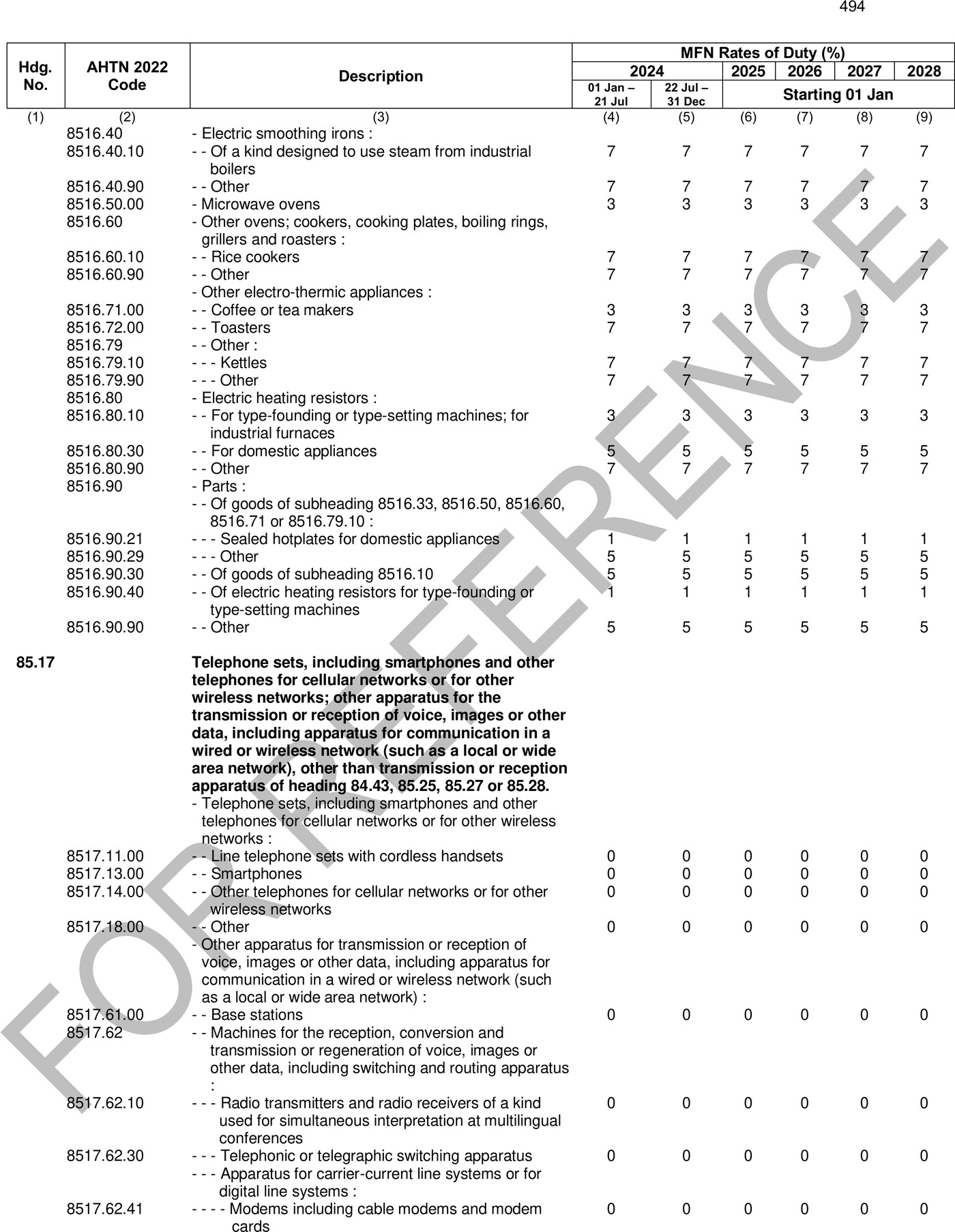
An actual excerpt from the official AHTN 2022 Tariff Book (Chapter 85 — Machinery and Electrical Equipment), as published by the Philippine Tariff Commission and implemented via CMC 97-2022. The highlighted row is the same 8517.13.00 “Smartphones” line used as the worked example in Border Solutions’ free Duties & Tax Calculator. Hover to locate it on the page.
The decision tree — weighted the way disputes actually weight it
Start here, every time
Read the heading text itself, plus any Section or Chapter Notes attached to it. Most products are settled at this rule alone, with no further analysis needed. A plain cotton T-shirt, a single-material plastic container, a bag of raw coffee beans — the heading text describes them directly, and that’s the end of the exercise.
Incomplete goods and mixtures
Two situations: an unfinished or unassembled product that already has “the essential character” of the finished item, and a material that’s mixed or combined with something else.
Composite and mixed goods Where disputes live
This is where the real disputes live, so spend your time here. GRI 3 applies whenever a product could reasonably fit under more than one heading — which, for SME product bundles, is often. It resolves in three steps, applied in order:
Most specific wins. If one heading describes the product more precisely than a general one, use the specific heading.
Essential character. If (a) doesn’t settle it, classify the whole item by whichever material or component gives it its essential character. The textbook illustration: a gift basket containing cheese, crackers, and a small bottle of wine doesn’t get classified as three separate items with three separate codes — it’s classified as a single set, by whichever component a reasonable buyer would say the set is fundamentally for. For an SME importer, the same logic applies to a promotional electronics bundle — say, wireless earbuds packaged with a charging case and a cleaning cloth. The earbuds are almost always the essential character; the case and cloth don’t get their own line.
Last heading in numerical order. If character genuinely can’t be determined — a true tie — the rule is mechanical: use whichever competing heading has the higher number. This is a tie-breaker of last resort, not a shortcut to skip 3(a) and 3(b).
Most akin
For the rare product that genuinely doesn’t fit anywhere in Rules 1–3, classify it under the heading for whichever existing product it most closely resembles. In practice, if you’re reaching for GRI 4, it’s worth pausing and double-checking Rules 1–3 first — true GRI 4 cases are uncommon.
Cases and containers
Specialized cases presented together with an article — a camera case sold with the camera, for instance — are classified with that article if they’re of a kind normally sold that way. Ordinary packing materials travel with the goods they’re packing unless they’re clearly reusable and suited for repeated use, in which case they may need their own classification. Relevant for anyone importing branded or premium packaging.
Subheadings
The same logic from Rules 1–5 gets reapplied one level down, inside whatever heading you landed on, to pick the right subheading. This is the rule that quietly governs everything below the 6-digit HS level — including the AHTN 8-digit and Philippine 10-digit layers from the section above.
From there, GRI 6 takes over to find the right 8-digit AHTN subheading within that heading — still governed by the same rule logic, one level down. The final two digits — the Philippine national line — aren’t a GRI question at all anymore. They’re determined by the AHTN 2022 schedule as implemented under CMC 97-2022, which is where you’d confirm the exact 10-digit line for that product category in the Philippine tariff book. GRI got you to the right heading; CMC 97-2022 tells you exactly where the Philippines subdivided it beyond that.
When to stop self-classifying and request a ruling
Self-classification using the method above is appropriate for most routine SKUs. It stops being appropriate — and it’s worth requesting a formal classification ruling instead — when: the duty differential between competing headings is large enough to matter financially; you’re bringing in a genuinely new product line with no prior classification history; the GRI 3(b) essential-character call is genuinely close rather than obvious; or you’ve already had a dispute with an examiner on a similar product once before. A ruling takes longer than a guess, but for the SKUs where it’s warranted, it converts a standing audit risk into a settled position you can point to indefinitely.
Self-classify
- Routine, previously-classified SKUs
- Heading text settles it at GRI 1
- Low duty differential between candidate headings
Request a ruling
- Large duty differential between competing headings
- Genuinely new product line, no classification history
- Close GRI 3(b) essential-character call
- Prior dispute with an examiner on a similar product
Sources & further reading
Every figure and rule cited in this piece traces back to one of the primary sources below.
The statutory basis for the 250% surcharge, the 10% no-surcharge floor, the 30% fraud presumption, and the 500% intentional/fraudulent surcharge.
Domestic implementation of the AHTN 2022 version — the tariff schedule this article’s sample page is drawn from.
The official text of GRI 1–6, binding on all HS Convention contracting parties, including the Philippines.
The HS Convention itself — in force since 1 January 1988, and the legal root of the 6-digit global HS layer.
Built on the same AHTN 2022 dataset referenced in this article — look up a code and estimate landed cost directly.